
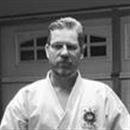
Sensei Doug Walker
Sensei Walker came to karate as a small kid with a big mouth, looking for the confidence not to be afraid of bullies.
After a few years at a large chain school, he realized something was missing. He wanted more than punching and kicking. He wanted a connection to the tradition of karate.
He found it in 1985, when a simple sign behind a movie theater in Azusa announced the grand opening of a Shobukan Okinawan Goju-Ryu dojo. He and a few friends marked their calendars and were there on opening day, making him one of the dojo’s original students, and later one of the original students of Tanzenbukan Goju-Ryu under Anthony C. Marquez Sr.
In that dojo, teaching the ranks below you was part of your own training, and as early as green belt he was working with newer students. As a brown belt, he ran the children’s and adult classes one day a week for nearly two years while his instructor recovered from a medical issue.
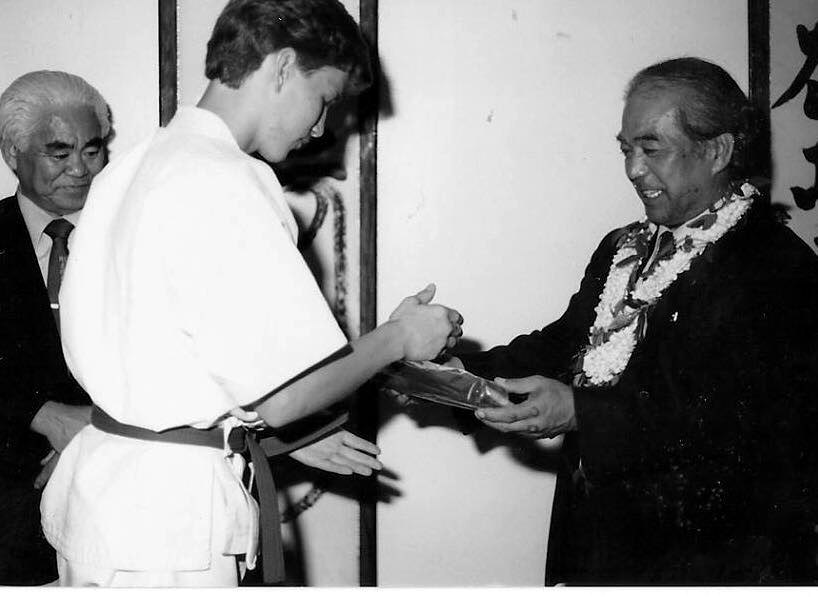
As a teen, Sensei Walker was fortunate to have the opportunity to meet Masanobu Shinjo, founder of Shobukan Goju-Ryu, and to test before him for 2nd kyu.
Leaving and coming back
College, career, and long commutes pulled him away from the dojo more than once. Over forty years, he has had to rebuild what he lost at least three times. Reaching a level of skill, letting it slide, and fighting to get it back is one of the hardest things a martial artist can do, and his teacher gave no breaks for being rusty. There were many days of rebuilding when his face turned purple because he refused to let his body set the limits of his training, even as it ran out of air. Each time, he returned with the mindset he was trained in:
Push yourself as hard as you can and go as long as you can. When you break, don’t be ashamed. Let that be the mark you pass tomorrow.
Leaving and coming back has shaped not only how he trains, but how he teaches.
Okinawa
In the mid-1990s, Sensei Walker traveled to Okinawa with a small group to train with Kaishu Isa, third-generation soke of Ufuchiku Kobujutsu. Over two weeks, Isa Sensei introduced them to karamiti, the old art that predates modern karate on Okinawa, and shared his Ufuchiku weapons. Sensei Walker helped document the training, and photographs from those sessions appeared in Bugeisha magazine. He trained with Isa Sensei twice more during his visits to the United States.
A home dojo
When work moved him away once more, he built a dojo at his home so he could keep training. Family members soon asked to bring their children, on the condition that they train alongside them. Students began inviting friends, and before long he was turning people away. He formally opened Redlands Traditional Martial Arts in 2013.
Over the years, roughly 30 students have trained with Sensei Walker. Four have earned shodan, and two of them went on to earn nidan. The training is demanding and honest from the first class, and students quickly learn whether it is the right fit.
Sensei Walker holds the rank of 5th dan and the title of Shihan. Today he teaches a small group of students at Redlands Traditional Martial Arts, home of the Dōshūkan family.
See our lineage, or contact Sensei Walker.